
When businesses think about HR, the focus is often on immediate needs. Hiring, onboarding, handling employee questions, or addressing issues as they come up.
What’s less visible is the ongoing time and effort required to keep everything running properly behind the scenes.
Over time, that effort turns into real cost. Not always in obvious ways, but in how time is spent, how decisions are made, and how risk is managed.
Here’s a closer look at what that can add up to.

Employment laws are constantly evolving, especially in states like California.
Keeping up requires more than just awareness. It means regularly reviewing updates, understanding how they apply to your organization, and adjusting policies or processes accordingly.
On average, this can take around 30 hours.
In many organizations, this responsibility is added to an existing role rather than handled by a dedicated HR function. Over time, that creates strain and increases the likelihood that something gets missed.

Without a structured HR approach, compliance often becomes reactive.
When questions come up, time is spent researching requirements, validating information, and trying to determine the right course of action.
That effort carries a cost, estimated at about $1,300 for 30 hours of research.
Even with that investment, there can still be uncertainty. Employment laws are nuanced, and applying them correctly often requires more than surface-level understanding.
This is something we recently covered in our Employment Law Update webinar, where even small changes can have broader implications if not handled correctly.

Not all compliance risks are obvious.
Some of the most common issues come from areas that are easy to overlook, such as labor law postings and required notices.
If these are outdated, incomplete, or missing, penalties can reach up to $17,000.
For many businesses, these gaps are not intentional. They are a result of limited visibility and the challenge of keeping up with ongoing requirements across multiple areas of HR.

An employee handbook plays an important role in setting expectations, ensuring consistency, and providing a foundation for how the organization operates.
Developing or updating a handbook, however, is a significant undertaking.
When you account for drafting, reviewing, aligning with leadership, and finalizing content, the process can take approximately 80 hours.
Because of the time involved, it is often delayed or revisited less frequently than it should be, which can leave organizations relying on outdated or incomplete guidance.

That level of time investment translates directly into cost.
Spending 80 hours internally on handbook development can amount to roughly $3,460, depending on who is involved in the process.
Beyond the time itself, there is also the consideration of accuracy. If policies are not aligned with current regulations or best practices, the organization may need to revisit the work or address issues after the fact.

California requires virtually all employers to have both an Injury and Illness Prevention Program (IIPP) and a Workplace Violence Prevention Plan (WVPP), which became enforceable on July 1, 2024.
Both plans should be customized to your specific workplace and supported by employee training. That process can take 20 to 40 hours of internal time, with an estimated cost of $2,500.
If Cal/OSHA finds either plan to be missing or incomplete during an inspection, citations and fines can follow.
THE FULL PICTURE
Each of these areas on their own may seem manageable.
But when you look at them together, a pattern starts to emerge. Time is pulled away from core business priorities, processes become inconsistent, and compliance becomes harder to maintain with confidence.
That’s where many organizations find themselves. Not doing anything wrong, just operating reactively, addressing issues as they come up instead of having a clear structure in place.
CREATING A MORE STRUCTURED AND AFFORDABLE APPROACH TO HR
HR doesn't need to feel like a constant drain on time or a source of uncertainty.
With the right structure in place, organizations can create more consistency across their processes, reduce exposure to risk, and better support their teams as they grow.
That structure typically comes from a combination of clear policies, reliable systems, and access to HR expertise when it’s needed.
Through HR Elite, we provide the resources and support to help bring that structure in place, so HR becomes more consistent, more proactive, and easier to manage.
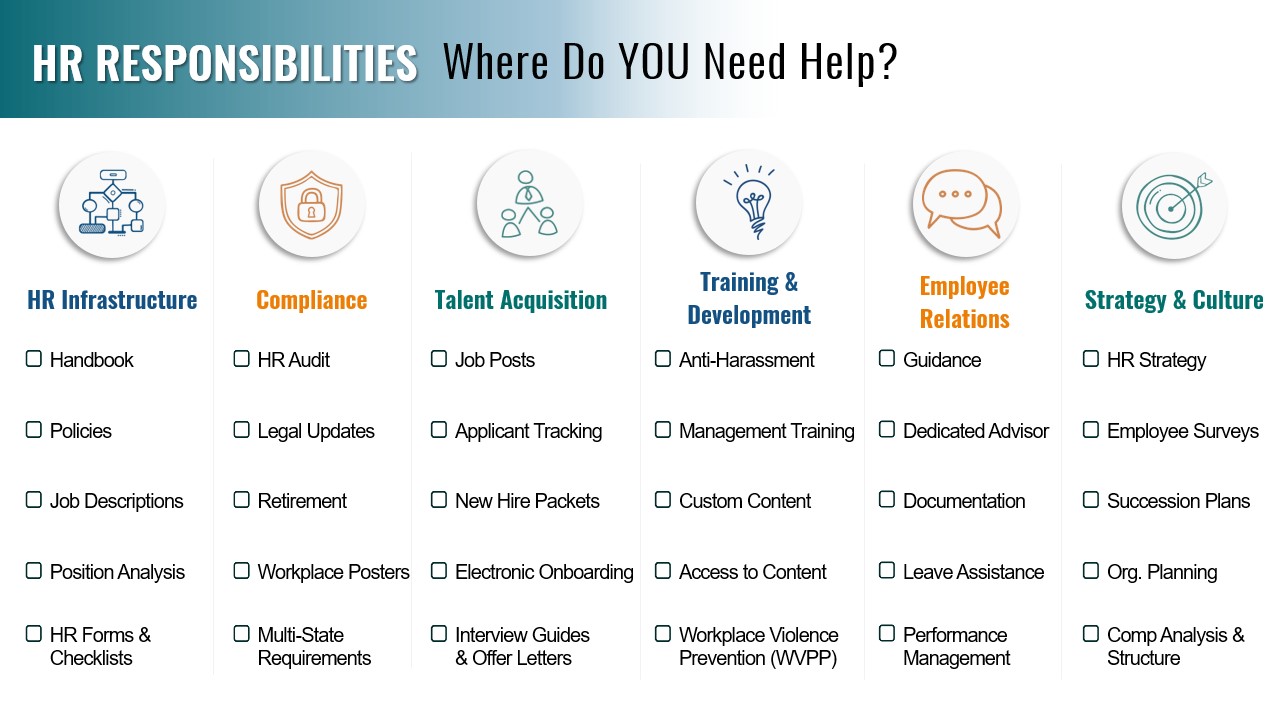
If any of these areas feel like they could benefit from more structure, clarity, or support, it may be worth taking a closer look at how your HR function is set up.
And if it’s helpful to talk it through, we’re always here as a resource.

.png)